Ever wondered about the glowing tubes in your device?
Our R&D team has gathered answers to the questions BioCharger users ask most about spectrum tubes: how they work, why they glow the way they do, why no two look quite alike, and when one actually needs replacing.
Why do some tubes shine brighter than others?
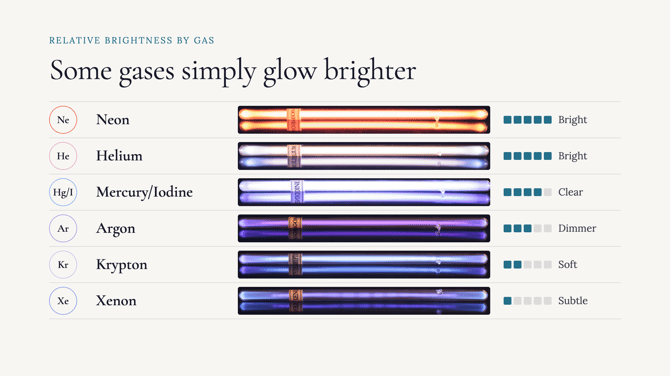
It’s not random. Each gas emits light according to its own makeup and the wavelengths it produces. Neon often looks far brighter than Xenon simply because the two respond to energy differently.
Neon – Bright. Easy to see during operation.
Helium – Bright. Adds to the overall energetic effect.
Mercury/Iodine – Clear glow, easily visible.
Argon – Typically dimmer than the others.
Krypton – Soft, pale whitish-violet glow; easier to spot in a darker room.
Xenon – Subtle. You may need to look closely to see it.
How does voltage affect the glow?
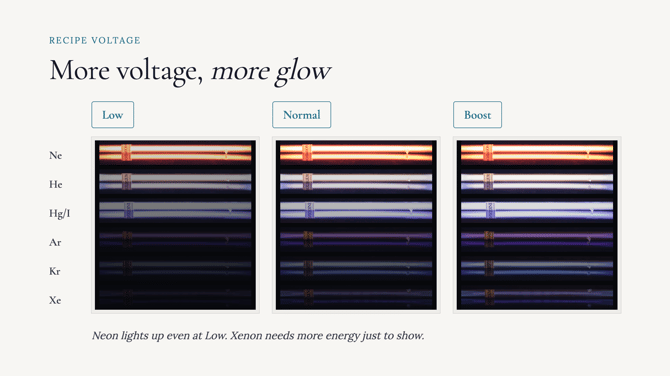
Your BioCharger’s voltage setting affects how brightly each tube glows. Recipes run at one of three levels: Low, Normal or Boost.
Depending on the gas and the voltage, some tubes may dim or go out entirely. Neon lights up at lower voltages; Xenon needs more energy just to flicker.
Is a flickering tube normal?
Don’t worry — it may be perfectly normal. Spectrum tubes need the right gas pressure to shine. Low pressure can make a tube look faint; high pressure can cause flickering or intense, jagged light.
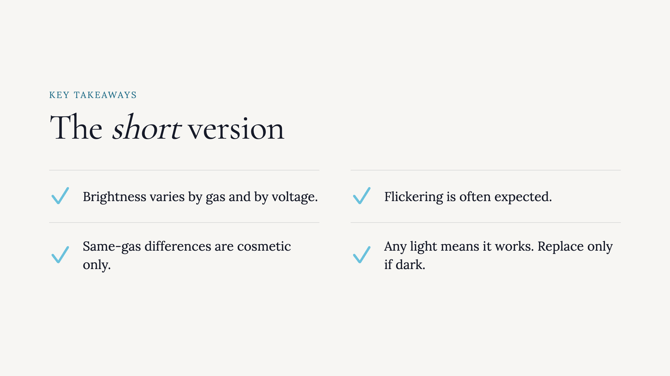
So yes — flickering is often expected.

Why do two tubes of the same gas look different?
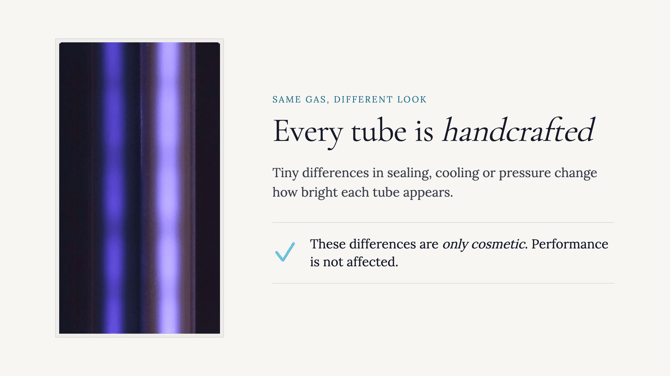
Every tube is handcrafted. Tiny differences in sealing, cooling or pressure can change how bright a tube appears.
These differences are only cosmetic — they don’t affect your BioCharger’s performance.
Why does a variety of tubes matter?
The tubes use gases naturally found in Earth’s atmosphere. When energized, they emit a spectrum of light — a form of light therapy that is absorbed by the body. Many gases mean many wavelengths: a broad range for maximum benefit.
How do I test my tubes?
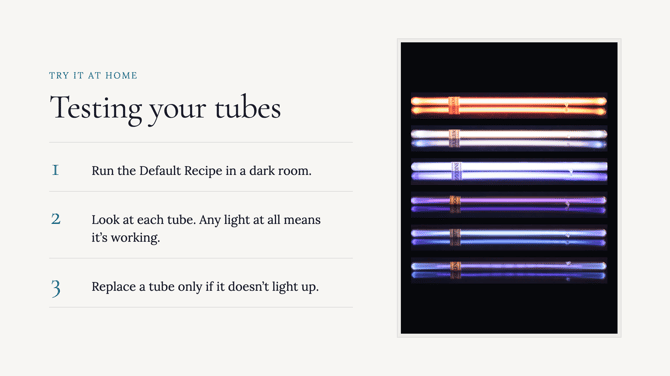
1. Run the Default Recipe in a dark room.
2. Look at each tube. If it emits any light at all, it’s still working.
3. Only replace a tube if it doesn’t light up at all.
My tube looks dark. Does it need replacing?
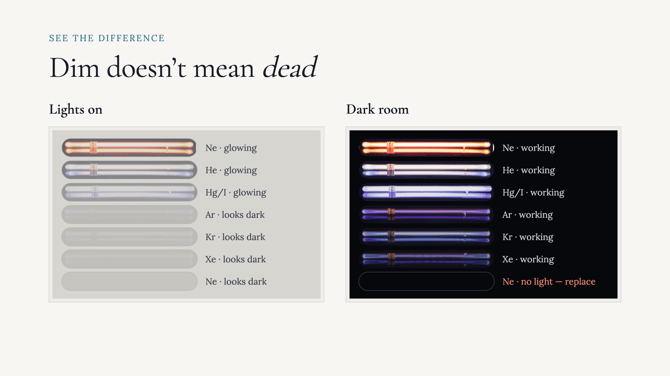
Not necessarily. With the room lights on, dimmer gases like Argon, Krypton and Xenon can look completely dark. Turn the lights down and they come into view.
A tube that stays dark in a dark room is the only one that needs replacing.